SCIENTIFIC FOUNDATION
Built on science. Validated in industry.
Scientific-grade modeling approaches developed for practical industrial application.
The SimVantage platform combines mechanistic modeling, CFD-informed engineering relationships and hybrid modeling approaches to support reliable decision-making in complex bioprocess environments.
Our methodologies are designed to provide physically consistent and scientifically grounded insight while remaining practical for industrial process engineering workflows.
Rather than relying on simplified heuristics alone, SimVantage integrates engineering-based analysis to evaluate:
- Hydrodynamics
- Mixing behavior
- Mass transfer limitations
- Scale-dependent effects
- Process sensitivities
This enables structured and transparent process understanding across development and production scales.
Our Scientific Partners










Scientific Publications
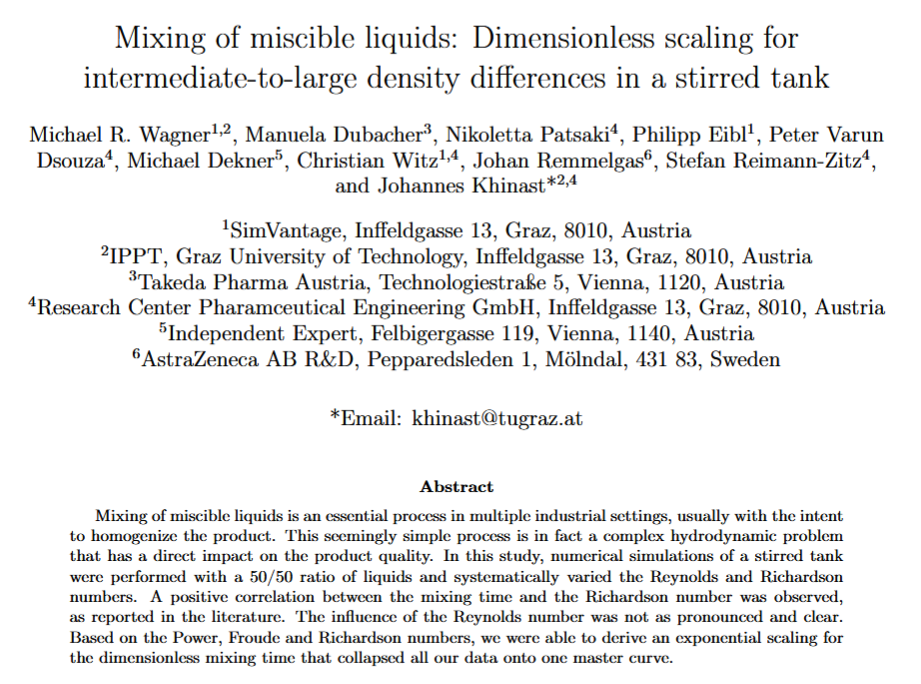
Mixing of miscible liquids: Dimensionless scaling for intermediate-to-large density differences in a stirred tank
Together with: TU Graz, RCPE, Takeda
Mixing of miscible liquids is an essential process in multiple industrial settings, usually with the intent to homogenize the product. This seemingly simple process is in fact a complex hydrodynamic problem that has a direct impact on the product quality. In this study, numerical simulations of a stirred tank were performed with a 50/50 ratio of liquids and systematically varied the Reynolds and Richardson numbers. A positive correlation between the mixing time and the Richardson number was observed, as reported in the literature. The influence of the Reynolds number was not as pronounced and clear. Based on the Power, Froude and Richardson numbers, we were able to derive an exponential scaling for the dimensionless mixing time that collapsed all our data onto one master curve.
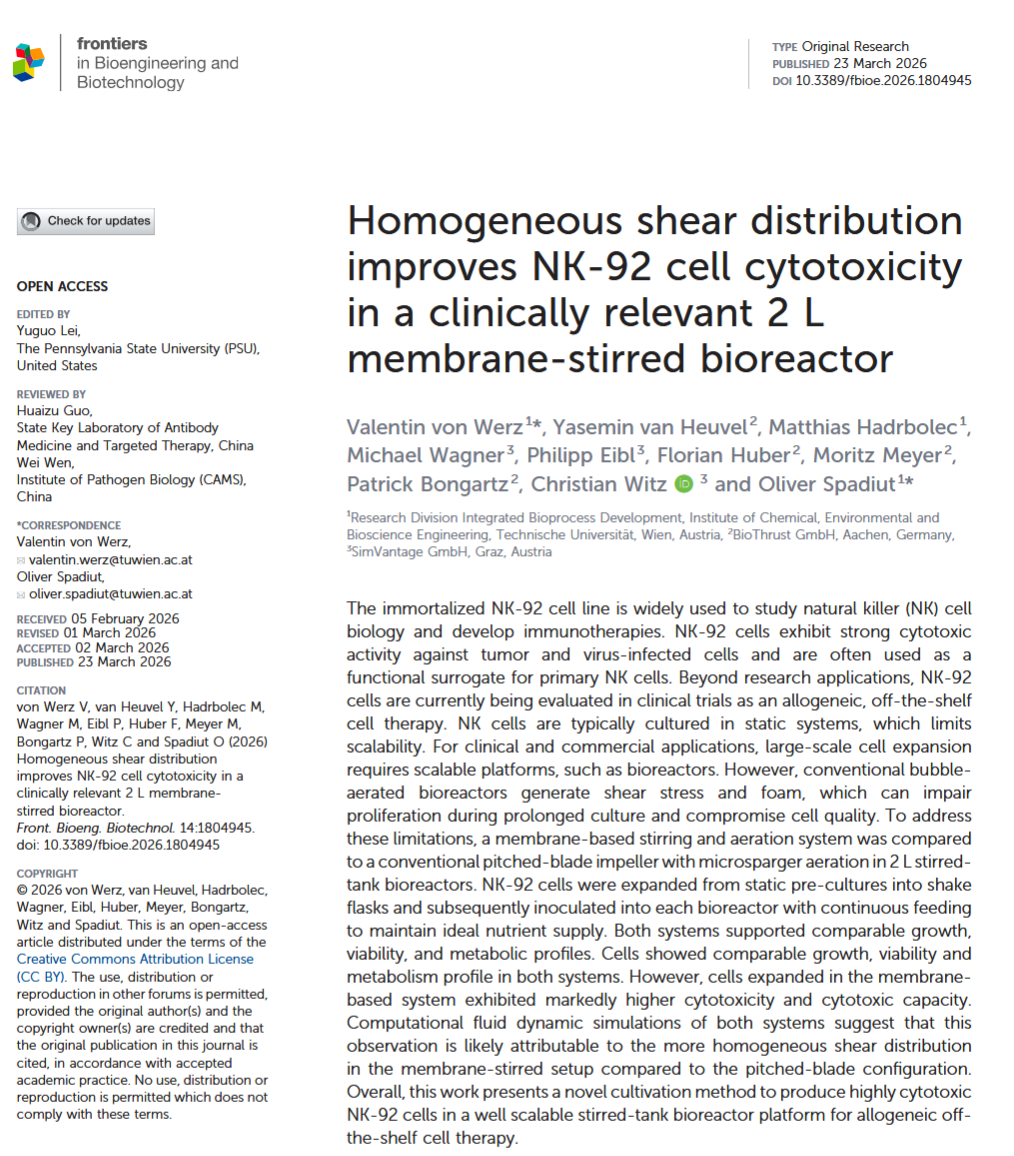
Homogeneous shear distribution improves NK-92 cell cytotoxicity in a clinically relevant 2 L membrane-stirred bioreactor
Together with: TU Vienna, BioThrust
The immortalized NK-92 cell line is widely used to study natural killer (NK) cell biology and develop immunotherapies. NK-92 cells exhibit strong cytotoxic activity against tumor and virus-infected cells and are often used as a functional surrogate for primary NK cells. Beyond research applications, NK-92 cells are currently being evaluated in clinical trials as an allogeneic, off-the-shelf cell therapy. NK cells are typically cultured in static systems, which limits scalability. For clinical and commercial applications, large-scale cell expansion requires scalable platforms, such as bioreactors. However, conventional bubble-aerated bioreactors generate shear stress and foam, which can impair proliferation during prolonged culture and compromise cell quality. To address these limitations, a membrane-based stirring and aeration system was compared to a conventional pitched-blade impeller with microsparger aeration in 2 L stirred-tank bioreactors. NK-92 cells were expanded from static pre-cultures into shake flasks and subsequently inoculated into each bioreactor with continuous feeding to maintain ideal nutrient supply. Both systems supported comparable growth, viability, and metabolic profiles. Cells showed comparable growth, viability and metabolism profile in both systems. However, cells expanded in the membrane-based system exhibited markedly higher cytotoxicity and cytotoxic capacity. Computational fluid dynamic simulations of both systems suggest that this observation is likely attributable to the more homogeneous shear distribution in the membrane-stirred setup compared to the pitched-blade configuration. Overall, this work presents a novel cultivation method to produce highly cytotoxic NK-92 cells in a well scalable stirred-tank bioreactor platform for allogeneic off-the-shelf cell therapy.